

In October 2025, Canva made Affinity completely free: the full photo, vector, and layout suite, no subscription, no catch beyond a free Canva account. That resets the comparison:
- Affinity: free now, was $70 one-time. Full PSD compatibility, RAW development, professional layers.
- Pixelmator Pro: $49.99 one-time, Mac only. Still the prettiest editor on macOS.
- Photoshop: $22.99/month. $275 a year, every year.
The one-time RAW set, counted
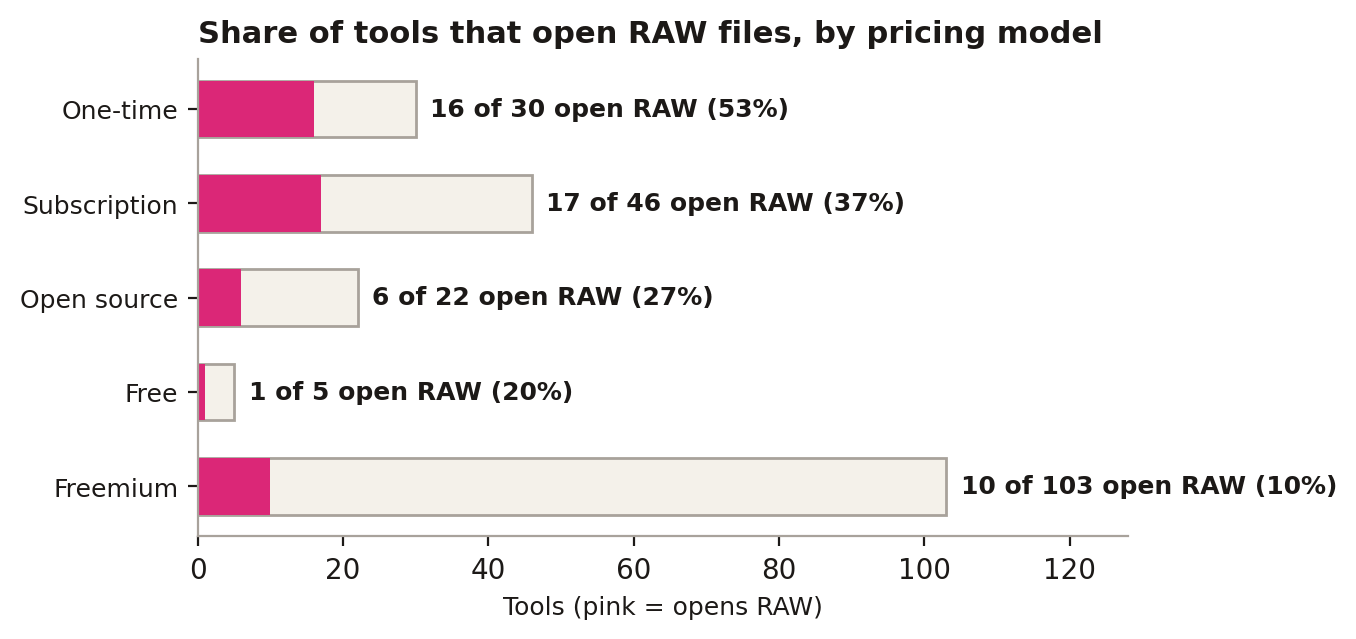
If you want to own your raw photo editing outright, the set is small and findable. Our database lists 30 one-time purchase tools across all categories, and 16 of them open RAW files: a 53 percent hit rate. No other pricing model comes close. Subscriptions manage 17 of 46 (37 percent), open source 6 of 22, free tools 1 of 5, and freemium just 10 of 103, because freemium apps keep RAW behind the paywall or skip it entirely. The 16 one-time RAW tools are not obscure utilities, either. They include ON1 Photo RAW, DxO PhotoLab, Pixelmator Pro, Corel PaintShop Pro, Exposure X, PhotoLine, Iridient Developer and SILKYPIX on the editing side, plus specialists like FastRawViewer for culling and Helicon Focus for focus stacking. In other words, the buy-it-once shelf covers the full RAW workflow: cull, develop, stack and finish.
Is it worth it?
At free, Affinity ends the debate for most photographers. Buy Pixelmator Pro only if you are deep in the Apple ecosystem and want its machine-learning tools. The wider math favors owning, too. Photoshop at $275 a year passes the price of most one-time editors before spring, and passes a $49.99 editor in about two months. A one-time RAW editor bought this year is still yours in five years, still opens the same files, and never greets you with a renewal screen. The honest trade-off is updates: subscriptions drip-feed new features, while one-time tools sell you the next major version as an upgrade. For RAW development, where the core job has been stable for a decade, that trade usually favors the buyer who pays once.
The 16, sorted by shape
The one-time RAW shelf is not 16 copies of the same app. Eleven of the 16 are pro photo editors: ON1 Photo RAW, DxO PhotoLab, Exposure X, SILKYPIX Developer Studio Pro, Iridient Developer, PhotoLine, Corel PaintShop Pro, Pixelmator Pro, FastRawViewer, Helicon Focus and Photomatix Pro. Three are consumer tools: PhotoScape X, Ashampoo Photo Commander and ON1 Resize. Two are AI image tools: DxO PureRAW and Radiant Photo. That spread matters because a RAW workflow is several jobs wearing one coat. There is the culling job, which FastRawViewer exists for. There is the developing job, where ON1 Photo RAW, DxO PhotoLab and Exposure X compete head-on. There are the specialist jobs: Helicon Focus for focus stacking, Photomatix Pro for HDR merges, DxO PureRAW for noise work before the main edit. A subscription suite bundles those jobs and charges rent on all of them forever. The one-time shelf lets you buy only the jobs you actually have, skip the rest, and add a specialist later for another single payment. That is the structural reason the 53 percent figure at the top of this page keeps winning photographers over: owning the workflow piece by piece is simply cheaper than renting it whole.
Run the five-year math and the gap stops being subtle. Photoshop at $275 a year costs $1,375 over five years. The one-time RAW shelf asks for a single payment per tool, and two of its best-known names, Pixelmator Pro at $49.99 and the now-free Affinity, sit at the very bottom of that range. Even a photographer who buys three one-time tools for three different jobs usually spends less than a single year of the subscription they replaced, and the tools keep working if the budget later goes to zero. Renting buys updates; owning buys permanence. For RAW files you may need to reopen in ten years, permanence has a value of its own.
Convert it free, too
Everyone else: take the free professional suite and spend the savings on preset packs. And keep the last step free as well. Convert it free: PicConvert handles the format chores, converting and compressing your finished files in the browser, so the one-time editor you own is the only software in your workflow that ever asked for money.
Sources: Adobe, Blackmagic Design